
Course DetailsHome / Courses Details
History
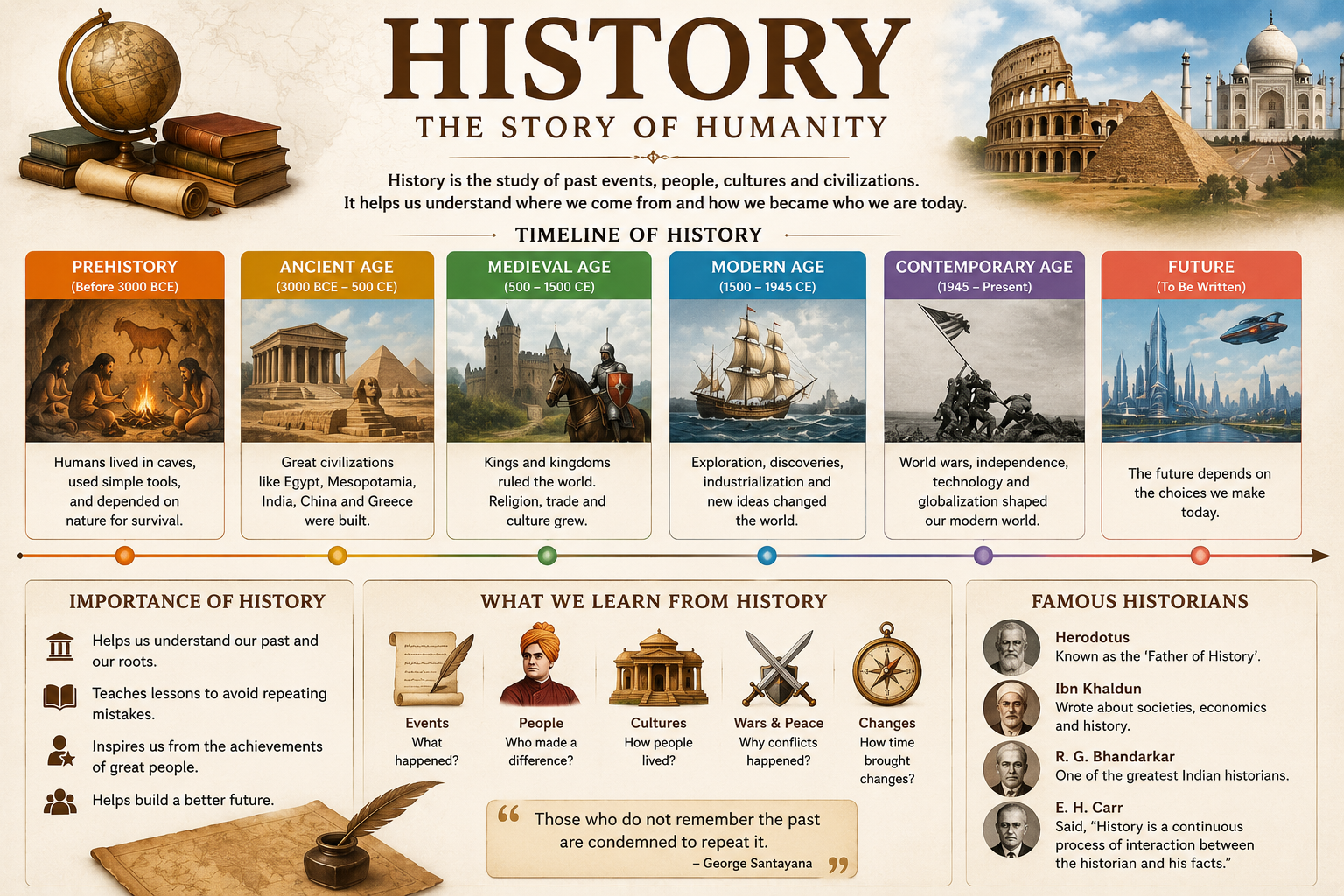
History is the study of past events, particularly those involving human societies, and the systematic effort to understand, record, and interpret them. It goes beyond simply listing dates and names — historians examine causes, consequences, and patterns to understand why events happened and how they shaped the world that followed. History relies on evidence such as documents, artifacts, oral accounts, and archaeological findings to reconstruct an accurate picture of the past.
History is a vast field covering different periods (ancient, medieval, modern) and different focuses, such as political history, military history, economic history, social history, and cultural history. Some historians specialize in a specific region or civilization — like Roman history or South Asian history — while others study broader themes that cut across time and geography, such as the history of trade, disease, or human rights. This range allows history to be examined from multiple angles, revealing different dimensions of the same era.
Historians reconstruct the past by carefully analyzing primary sources (firsthand documents, letters, artifacts from the time) and secondary sources (later interpretations and analyses). Because sources can be incomplete, biased, or contradictory, historians must critically evaluate evidence, cross-reference multiple accounts, and remain aware of the perspective from which a source was written. This is why historical interpretation can shift over time — new evidence, or a fresh way of looking at old evidence, often leads to revised understanding of past events.
Studying history helps us understand how the present came to be — how political systems, cultural values, technologies, and social structures evolved over time. It also offers valuable lessons: examining past successes and failures, conflicts and resolutions, can inform better decision-making today. Beyond practical lessons, history fosters empathy and perspective, helping people understand experiences and viewpoints different from their own by seeing how earlier generations lived, struggled, and thrived.
In a world facing rapid change, history remains a crucial guide — many contemporary issues, from political tensions to economic policies to social movements, have deep historical roots that are essential to understanding their present-day form. Studying history cultivates critical thinking, since it requires weighing evidence, recognizing bias, and constructing reasoned arguments — skills valuable far beyond the subject itself. Ultimately, history connects us to those who came before us, reminding us that today's world is the product of countless decisions, struggles, and changes across generations.

TechGigs School Management Software simplifies school tasks, allowing teachers to efficiently manage attendance and grades. By streamlining their work, teachers can focus more on helping students succeed.