Course DetailsHome / Courses Details
Science
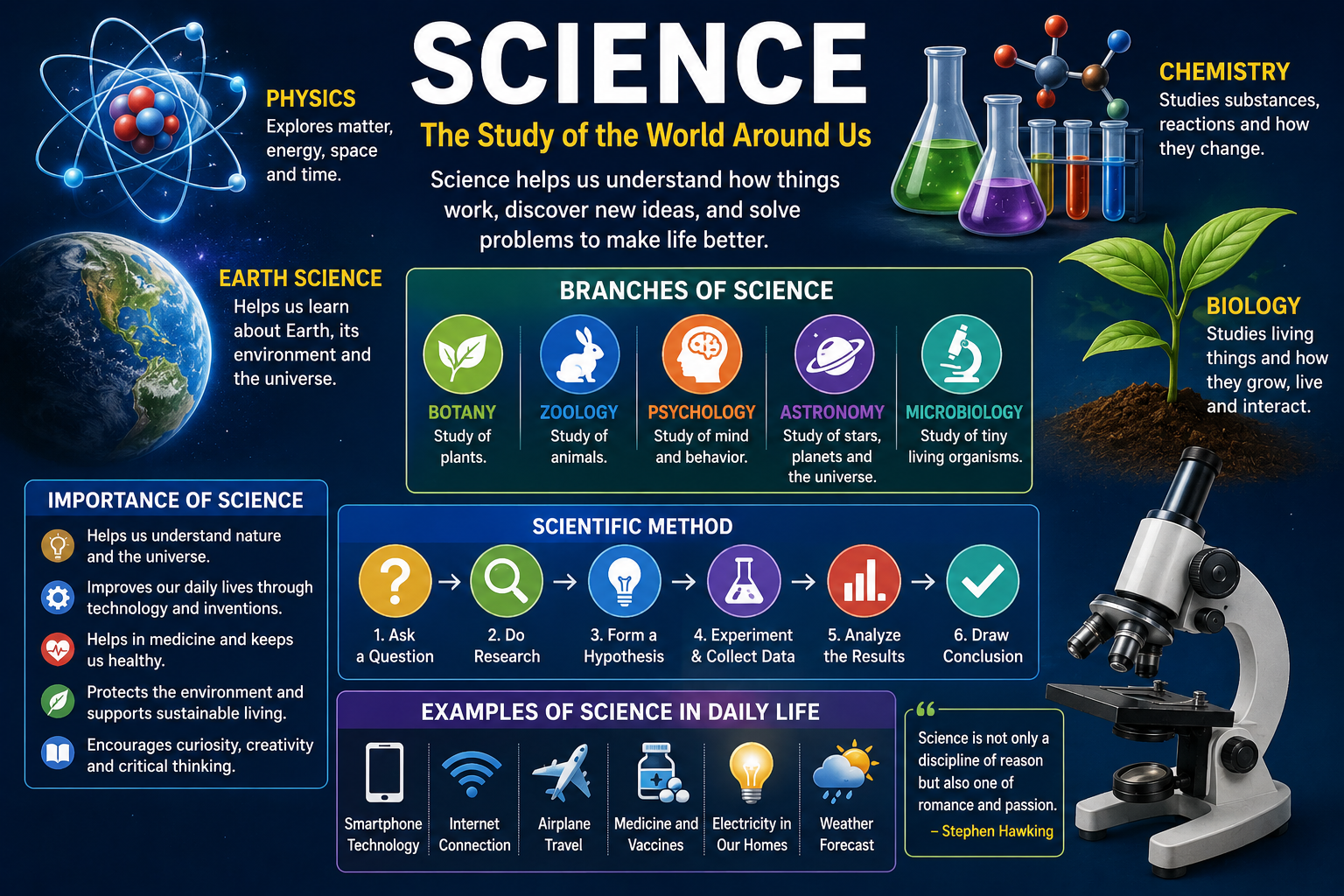
Science is a systematic method of understanding the natural world through observation, experimentation, and evidence-based reasoning. Rather than relying on assumption or belief, science builds knowledge by forming hypotheses, testing them rigorously, and revising conclusions when new evidence emerges. This process — known as the scientific method — is what separates science from other ways of explaining the world, because every claim must be testable and open to being proven wrong.
Science is broadly divided into natural sciences, which study the physical world (physics, chemistry, biology, earth science, astronomy), and social sciences, which study human behavior and societies (psychology, sociology, economics). Within these, countless subfields exist — genetics, neuroscience, ecology, particle physics — each focused on a specific slice of reality but united by the same core commitment to evidence and testable explanation. Mathematics, while not strictly a natural science, serves as the language through which most scientific theories are expressed and verified.
Scientific progress rarely comes from a single experiment or a lone genius; it's a cumulative, collaborative process. Researchers publish their findings, other scientists attempt to replicate and challenge those results, and over time a body of well-tested, peer-reviewed knowledge builds up. This self-correcting nature is one of science's greatest strengths — theories that don't hold up to scrutiny eventually get discarded or refined, while robust ideas gain the status of well-established scientific consensus (though even those remain open to revision if compelling new evidence arrives).
Science underpins nearly every aspect of modern life, from the medicine that treats disease to the technology that powers communication, transportation, and energy. Vaccines, antibiotics, electricity, computers, and space travel are all direct products of scientific inquiry. Beyond practical inventions, science also shapes how societies make decisions — informing public health policy, environmental regulation, and technological development — which is why scientific literacy matters not just for scientists, but for everyone navigating an increasingly complex world.
At its core, science represents humanity's most reliable tool for separating what's true from what merely sounds true. It teaches habits of mind — skepticism, curiosity, willingness to be wrong — that extend far beyond the laboratory into everyday decision-making. As new challenges arise, from climate change to emerging diseases to artificial intelligence, the scientific method remains the most trustworthy compass for understanding these problems and working toward solutions grounded in evidence rather than speculation.

TechGigs School Management Software simplifies school tasks, allowing teachers to efficiently manage attendance and grades. By streamlining their work, teachers can focus more on helping students succeed.